
When a Palm Pressure Sensor Changed Neonatal CPR
There is a measurement problem at the heart of neonatal CPR that does not get enough attention.
When a newborn's heart stops, a trained clinician places their thumbs on a chest roughly the size of a fist and begins compressions. The guidelines specify 90 per minute, one third of the anterior-posterior chest diameter, and full recoil between each compression. What the guidelines cannot tell you is how much force is actually being applied. Not because nobody cared, but because nobody had found a reliable way to measure it.
That is where this story begins.
A sensor built for hands, not chests
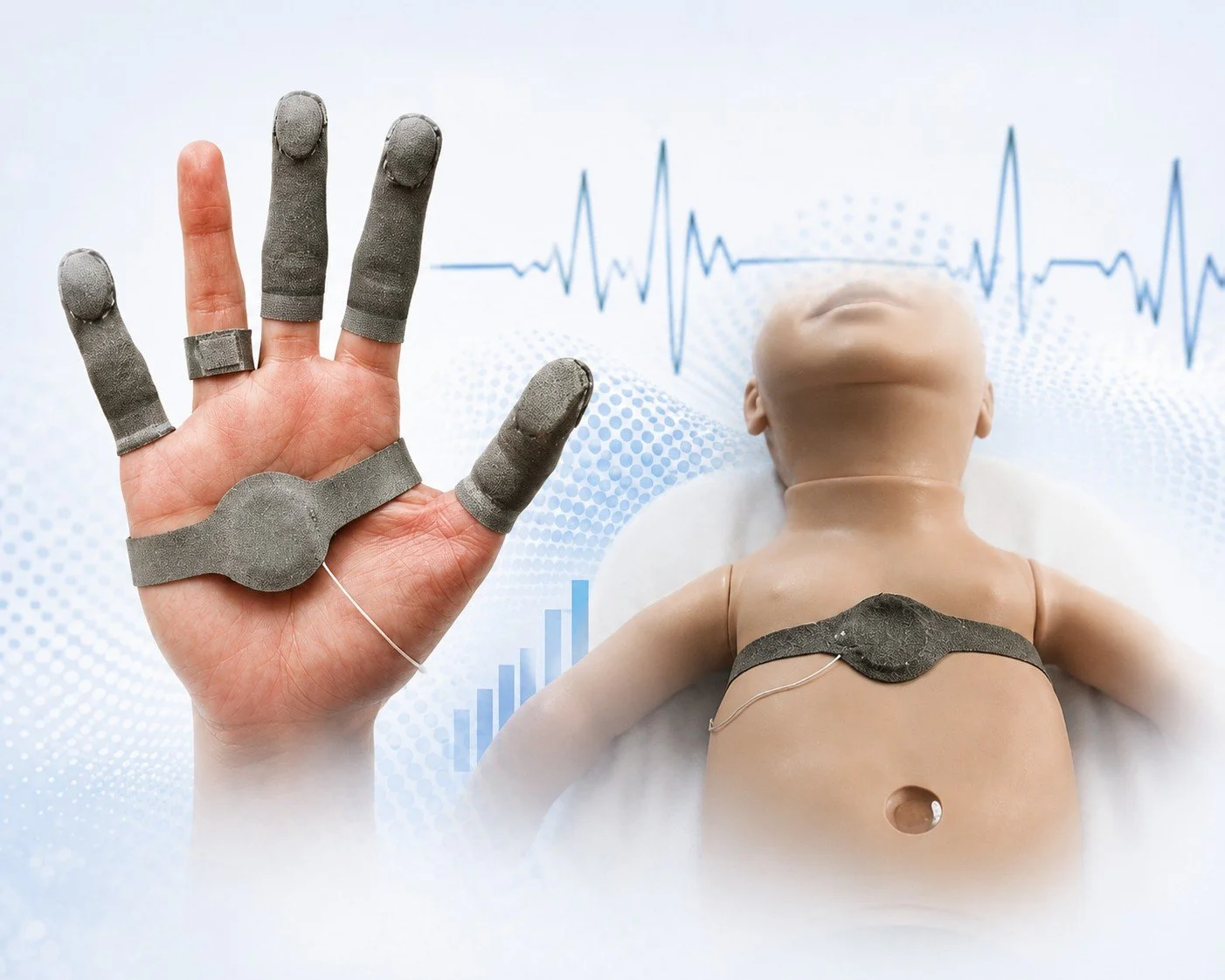
The FingerTPS system was developed by PPS to measure the force exerted on an object during gripping. Two-millimetre-thin capacitive sensors sit on the fingers or in the palm of the hand, capturing contact pressures in real time. Before this research, the system had found its home in surgical training, sports science and ergonomics studies. It was, by design, a hand sensor.
In 2015, a research team at the University of Alberta and Akershus University Hospital in Norway asked a question that had nothing to do with hands. Could the FingerTPS palm sensor, strapped to the chest of a newborn manikin, measure the force applied during chest compressions?
The sensor was built to record what hands do to objects. These researchers wanted to know what hands do to a sternum. It was not an obvious application. They tried it anyway.
Study one: proving the concept
The team positioned the FingerTPS palm sensor, 2mm thin and 2.5cm² in area, around the lower third of a neonatal manikin's sternum. This is precisely where trained clinicians are taught to focus thumb pressure during CPR.
Fifty-three Neonatal Resuscitation Program healthcare professionals each performed five minutes of chest compressions. The sensor recorded force continuously, capturing both the peaks of each active compression and the force remaining between compressions. That second measurement mattered. It revealed whether clinicians were fully releasing pressure between compressions or unknowingly maintaining a residual load on the chest wall, a problem known as leaning, which reduces the effectiveness of each subsequent compression.
The findings, published by Solevåg AL, Cheung PY, Li E, et al. in the Journal of Maternal-Fetal & Neonatal Medicine (2015), confirmed that the FingerTPS could reliably measure both compression rate and applied force in this setting. The authors concluded that the system was potentially useful in teaching, training and clinical CPR through real-time force feedback, but that more research was needed.
More research followed.
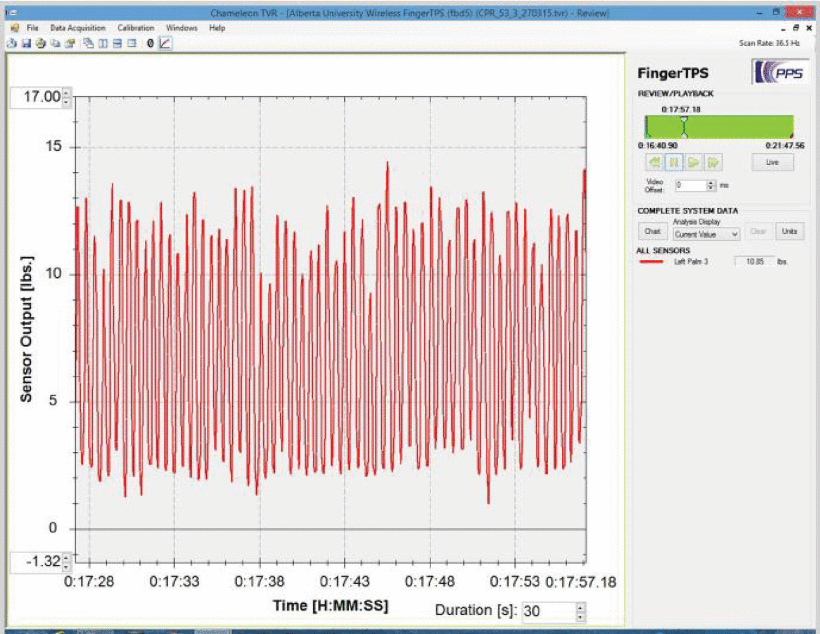
Figure 2: Raw FingerTPS force measurements recorded during simulated neonatal chest compressions. Peaks represent active compression force; troughs represent residual leaning force between compressions. Recorded using PPS Chameleon software. Source: Solevåg AL, Cheung PY, Li E, et al. Chest Compression Quality in a Newborn Manikin: A Randomized Crossover Trial. IEEE Journal of Translational Engineering in Health and Medicine. 2018;6:1900405. DOI: 10.1109/JTEHM.2018.2863359
Study two: what the numbers revealed
The same team, now expanded across the Departments of Pediatrics and Surgery at the University of Alberta and Akershus University Hospital, used the FingerTPS as the primary measurement instrument in a full randomised controlled trial.
Published by Solevåg AL, Cheung PY, Li E, et al. in the IEEE Journal of Translational Engineering in Health and Medicine (2018), the study examined how compression force and rate changed over five minutes of simulated neonatal CPR, comparing two target compression rates and testing whether metronome guidance made a difference.
The results were not what most people expected. The median peak force recorded across all participants was 16 lbs, but the interquartile range ran from 9 to 35 lbs.
Among trained, registered professionals, performing a clearly defined task under controlled conditions, the force being applied to a newborn's chest varied by nearly fourfold. The metronome kept compression rates closer to target, but it had no influence whatsoever on how hard clinicians actually pressed.
The conclusion was plain: compression rate guidance alone is not enough. Force quality is highly variable, it goes largely unmeasured in real clinical environments, and without measurement it cannot be taught, corrected or improved. The paper called for real-time feedback systems capable of capturing not just rate, but force, depth and leaning during neonatal CPR. The FingerTPS data had made that case.
From a simulation study to global guidelines
Both papers were subsequently cited by ILCOR, the International Liaison Committee on Resuscitation, in their systematic review of CPR feedback devices for neonatal cardiac arrest. ILCOR produces the evidence reviews that feed directly into the clinical guidelines published by the American Heart Association and the European Resuscitation Council. These are the guidelines that shape how clinicians are trained, what feedback tools are used, and how neonatal resuscitation is practised in hospitals around the world.
The same core research group went on to conduct the SURV1VE trial, a cluster randomised controlled trial comparing CPR techniques in asphyxiated newborns, published in the Archives of Disease in Childhood in 2024. The programme of research that started with a grip sensor on a manikin's sternum is still generating clinical evidence today.
What this says about force measurement in medicine
Medical environments carry a long tradition of relying on trained feel. A procedure looks correct, the clinician is experienced, and the outcome is assumed to follow. In many contexts that judgement is well founded. In neonatal CPR, where the difference between too little and too much force on a fragile chest has direct physiological consequences, it is not a sufficient standard.
What these studies showed, clearly and with peer-reviewed data, is that force during chest compression is not consistent even among trained professionals. It varies widely, it goes undetected without instrumentation, and the tools most commonly used to standardise CPR performance, like audio pacing, do not address it.
Tactile sensing exists precisely for this kind of problem. Not to second-guess clinical expertise, but to make measurable what has always been invisible. To move training and practice from subjective feel towards objective, repeatable data. At PPS, this is the kind of challenge we have always been drawn to, problems where force directly affects human outcomes and where honest measurement is the only way to understand what is really happening.
The sensor did not need to change
The FingerTPS was not modified or redesigned for this research. No new hardware was developed. A research team identified a measurement problem, recognised that the physics of the challenge matched what the sensor already solved, and applied it in a new context.
That is engineering versatility in its most straightforward form. Not reinvention, but clear problem definition and the confidence to apply an existing tool where nobody had thought to use it before.
A decade on, two peer-reviewed studies, a citation in international resuscitation guidelines, and an ongoing programme of clinical research all trace back to a 2mm sensor strapped to a manikin's chest.
Interested in how PPS tactile sensing is used in medical research and clinical applications? We work with research teams, device developers and clinicians on problems where force and pressure directly affect human outcomes.